
Rental owners — unlock $20K–$40K in Year-1 deductions

Cost segregation for residential rentals.
10 minutes. $499. No signup.

We reclassify parts of your property into 5- and 15-year categories so you can write more off in Year 1 — instead of spreading it over 27.5 years as prescribed by law.

Free · No signup · IRS-aligned · 1–4-unit, $1M basis

Average Year-1 Savings*

Year 1
$27,300 *

vs. standard straight-line depreciation

Modeled on a $420k rental, 22% reclass, 37% bracket

What gets reclassified — visualized

A typical residential rental has roughly 22% of its depreciable basis sitting in components that qualify for shorter recovery periods. Cost segregation moves those from the 27.5-year structure schedule onto 5-year and 15-year schedules — accelerating Year-1 deductions.
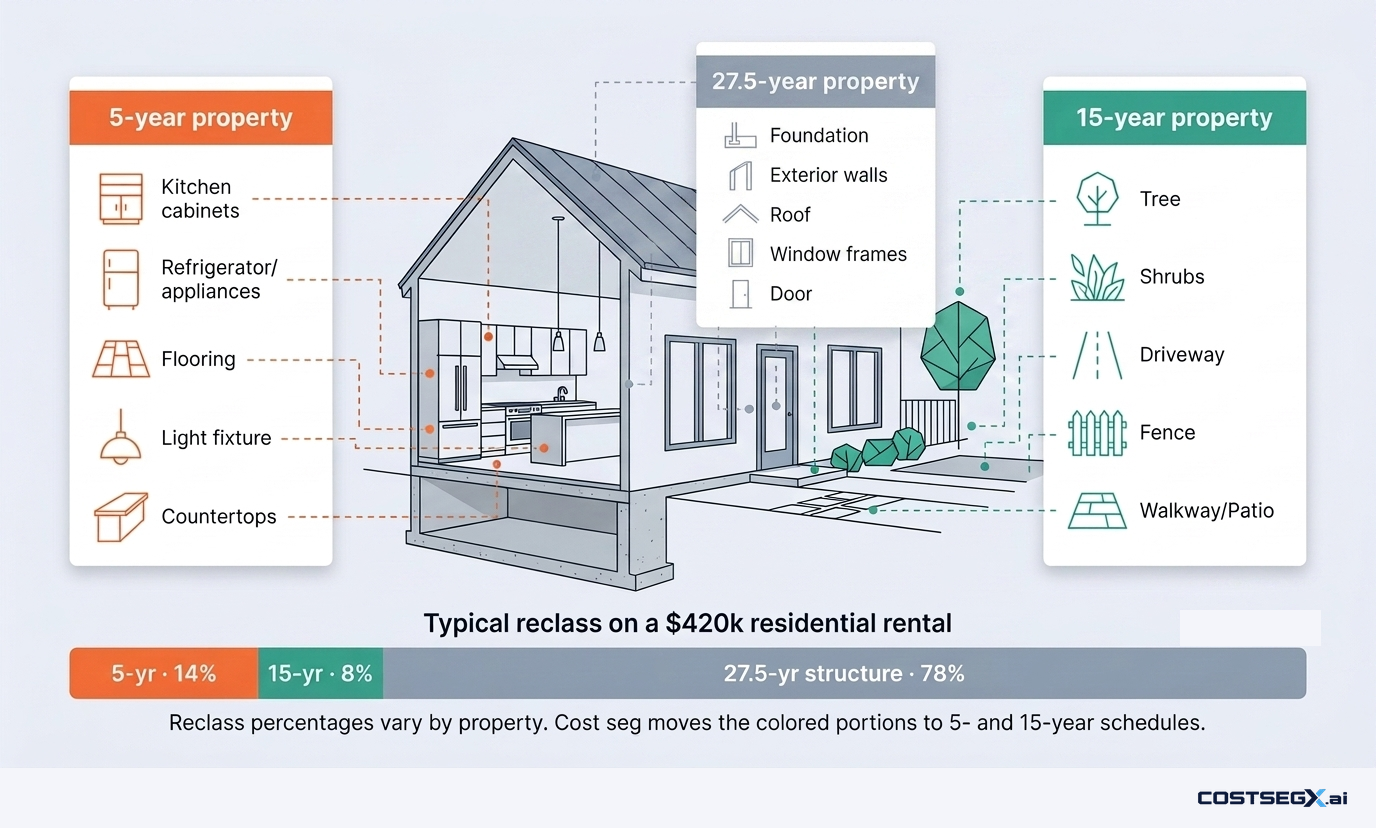
Labeled house diagram showing which residential rental components reclassify into 5-year personal property (kitchen cabinets, refrigerator, appliances, flooring, light fixtures, countertops), 15-year land improvements (trees, shrubs, driveway, fence, walkway, patio), and 27.5-year structural components (foundation, exterior walls, roof, window frames, doors). Bottom stack bar shows typical reclassification of 22% on a $420k residential rental: 14% to 5-year, 8% to 15-year, 78% remaining as 27.5-year structure.

Illustrative example based on a $420,000 residential rental. Reclass percentages vary by property type, age, and construction. Your CostSegX report calculates the exact split for your specific property.

Try your numbers

Estimate your Year 1 savings

Year 1 — without cost seg

$2,825

standard 27.5-year schedule

Year 1 — with cost seg

$36,392

first-year tax savings

First-year multiple

12.9×

vs. Year-1 standard depreciation

Annual tax savings, year-by-year

Without cost seg With cost seg
$0 $13k $25k $38k $50k 14710131619222528 Year

Adjust your inputs

$525,000
37%

Assumptions

  • Depreciable basis: $420,000 — 80% of purchase price (20% land, residential rental average).
  • Reclassification: 22% of basis to 5- and 15-year property (residential rental average; your study calculates the exact split).
  • Bonus depreciation: 100% on property acquired and placed in service on or after January 19, 2025.

Illustrative estimate. Actual savings depend on your property, basis, acquisition date, and tax situation. Consult your CPA.

What is Cost Segregation?

Cost segregation is an IRS-approved tax strategy that lets you write off parts of your rental property faster. Normally, the IRS makes you spread your tax deductions evenly over 27.5 years. A cost segregation study breaks your property into categories — some that can be written off in just 5 or 15 years — so you get bigger tax savings upfront.

Read the full AI cost segregation methodology or our IRS Pub 5653 source citations.

Why CostSegX.

What you get for $499 — and what traditional firms charge for each piece.

Minutes, Not Weeks

Get your report the same day you start. No site visit. No 4–8 week wait for a consultant.

IRS-Aligned Methodology

Component-level MACRS schedules built on engineering-based methodology consistent with IRS Publication 5653. Includes §1245 recapture and state conformity warnings (CA, NY, NJ).

No Tax Expertise Required

A 10-minute guided form. AI auto-fills 30+ property fields from public records. Built for investors, not for CPAs.

Flat $499. No Hidden Fees.

One price covers everything: site visit, Form 3115 catch-up worksheet, recapture schedules. Free corrections for 14 days. No rush fees, no revision fees, no add-ons.

Side-by-Side

What you pay for CostSegX Traditional CPA firm
Total cost $499 flat $5,000–$15,000
Delivery time Same day 4–8 weeks
Revisions Free, 14 days $200–$500 each
Site visit fee Included $500–$2,000
Rush fees None $500–$2,000
Form 3115 (look-back) Included Often extra
State conformity warnings Auto Manual / sometimes omitted
§1245 recapture schedule Included Often extra

Traditional-firm pricing reflects market rates for residential 1–4 unit cost segregation studies and varies by firm and property complexity. CostSegX serves residential 1–4 unit rentals up to $1M depreciable basis.

Built for Accuracy

Our AI doesn't just collect data — it verifies every detail.

Multi-Source Collection

Property records, satellite imagery, and listing data — all gathered in seconds.

Public records
Satellite imagery
Listing data

AI Extraction

AI reads through all the data and fills in 30+ property details automatically, rating how confident it is for each one.

Property type & size
Features & finishes
Exterior & interior

AI Verification

AI-powered validation runs on every field — automated anomaly detection catches outliers and unusual entries before you submit.

Catches unusual entries
Knows what's typical for your property type
Checks that everything adds up

How It Works

Four simple steps to maximize your tax savings.

1

Enter Your Address

Type your property address. Our system pulls building details from multiple sources in seconds.

2

AI Collects

Our system cross-references public records, satellite imagery, and listing data to build a complete property profile — 30+ fields filled automatically.

3

AI Reviews

Before your report is generated, an AI agent runs automated validation and anomaly detection on every field. If something looks off, you'll know.

4

Get Your Report

Download your IRS-ready cost segregation report with component-level engineering analysis and full depreciation schedules.

Simple Pricing

One price. No hidden fees. No upsells.

Residential Cost Segregation Report

$499

per property

  • IRS-ready report with depreciation schedules
  • Component-level property analysis
  • AI-powered property analysis
  • Built-in AI verification for data accuracy
  • Instant delivery (minutes, not weeks)
  • Free edits for 14 days
  • Properties up to $1M basis

Frequently Asked Questions

A cost segregation study identifies and reclassifies components of your rental property into shorter depreciation categories (5-year and 15-year) instead of the standard 27.5 years. This accelerates your tax deductions, putting more money back in your pocket sooner.
Any owner of residential rental property (1-4 units) that is used for investment purposes. This includes single-family rentals, duplexes, triplexes, fourplexes, townhouses, and condos. Both long-term and short-term rentals (Airbnb, VRBO) qualify.
Minutes, not weeks. Our AI analyzes your property and generates a complete report almost instantly. Traditional cost segregation firms take 4-8 weeks.
Yes — engineering-based methodology consistent with IRS Publication 5653 (the Cost Segregation ATG), including MACRS depreciation schedules and proper §1245/§1250 classification. The report includes component-level property analysis with supporting documentation.
Residential rental properties with 1-4 units and a depreciable basis up to $1,000,000. This covers single-family homes, duplexes, triplexes, fourplexes, townhouses, and condos.
Yes. You get 14 days of free edits after purchase. Update any property details and re-generate your report at no extra cost.
Bonus depreciation allows you to deduct a large percentage of qualifying assets in the first year. Under current law (OBBBA), properties both acquired AND placed in service on or after January 19, 2025 qualify for 100% bonus depreciation on 5-year and 15-year property.
Absolutely. Cost segregation works for any residential rental property — whether you have long-term tenants or list on Airbnb, Vrbo, or any vacation rental platform. The tax benefits are the same: you get to write off parts of your property faster, which means bigger tax savings sooner.
If you actively manage your rental — handling bookings, guest communication, cleaning, turnover — you may be able to use those larger write-offs to reduce not just your rental income taxes, but your overall income taxes. This is a big deal: a typical long-term landlord can only use these deductions against rental income, but active Airbnb/Vrbo hosts may be able to apply them more broadly. Ask your CPA if you qualify — they'll know based on how involved you are in managing the property.
Bonus depreciation lets you write off certain property components entirely in Year 1, instead of spreading it over 5 or 15 years. For properties both acquired AND placed in service on or after January 19, 2025, the bonus rate is 100% — meaning you could deduct a significant chunk of your property's value right away. For Airbnb and Vrbo hosts, this can mean a major tax reduction in the first year you start renting.
Yes — during the property details step, you can mark your property as a short-term rental. This gets included in your report so your CPA has the full picture. The study itself works the same way regardless of how you rent the property — your CPA will handle the tax filing details based on your specific situation.